Thursday, May 8, 2014

Buffman and Gram's Vegetables for Vitality: Carrots


As many of you know Allen, Sterling & Lothrop's fourth generation has been getting more and more involved in the business.  You may have met Jenn's (AS&L's seed room manager) daughter Nadia running the front with her grandmother, Shirley, or  you may have had one of Shawn's boys help you with a Christmas tree.

This year Buffman (Shawn's middle son) has joined forces with his grandmother, Shirley, to bring you their thoughts on the healthiest vegetable's you can grow.  They consulted Shirley's vast knowledge of gardening and nutrition and  www.whealth.com
-------------------------------------------------
Carrots are easy to grow and high in nutrients; in particular vitamin A.  They are very high in beta-carotene, which helps slow down the aging of cells. Carrots help with the good health of your skin. Some say that eating carrots regularly can help reduce LDL cholesterol level.
When planting carrots work the soil good and deep. Take out any rocks or clods of soil. Improve the soil with lots of compost for larger sweeter carrots. As carrots start to grow thin them to 2 inches apart. 
Carrots are an amazing vegetable that can be eaten either raw, or cooked.  Did you know that carrot tops are edible?  Try using carrot greens as a vegetable or as an herb like parsley.
Carrots are essential in stews, soups, boiled dinners etc.  Try cooking them in a skillet with butter, add a good handful of freshly chopped parsley just prior to serving. 


Thursday, May 1, 2014

Bill answers common early spring questions

A common site this winter...


This season has definitely gotten off to a slow start!  It has been a particularly challenging winter that left us with a lot of winter kill, deer & rodent damage.  If your plats are experiencing winter damage—(i.e. stress) this is a good time to fertilize with Holly Tone, Plant Tone, etc. We also recommend using a product called PHC Bio-Pak Plus which adds a lot of micro-nutrients to the soil and is a root stimulator.  We have found this works very well on stressed plants. 

One question I am frequently asked this time of year –Is it normal for my conifers to be shedding needles on the inside?  Just as deciduous trees shed leaves, conifers shed needles before pushing new growth. 

If you have had winter kill or deer damage now is the time to prune back the plant to encourage the dormant buds to grow.  In the case of rhododendrons you may be pruning off some of this year’s flowers; but, I believe it is better for the plant to be using its resources to produce new leaves and new growth.

Another great thing to do this time of year –as I was just discussing with one of our customers—weed early and often;  try to get the weeds before the weeds have a chance to set a good root system. 

In the case of rodent damage on trees and shrubs girdling the bark (hopefully they have not gone completely around the plant) you can remove lose bark and possibly use Tree Kote or Tree Wrap to protect the tender bark.  Unfortunately, if they have created a continuous cut around the trunk it is impossible for the plant to draw water and nutrients and the plant will not survive.

Thursday, April 10, 2014

Buffman and Gram's Vegetables for Vitality: Kale


As many of you know Allen, Sterling & Lothrop's fourth generation has been getting more and more involved in the business.  You may have met Jenn's (AS&L's seed room manager) daughter Nadia running the front with her grandmother, Shirley, or  you may have had one of Shawn's boys help you with a Christmas tree.

This year Buffman (Shawn's middle son) has joined forces with his grandmother, Shirley, to bring you their thoughts on the healthiest vegetable's you can grow.  They consulted Shirley's vast knowledge of gardening and nutrition and www.wiki.com
----------------------------------------------------------

 
Kale has the second highest antioxidant concentration of other vegetables. It is very high in beta carotene, vitamin K, vitamin c, and rich in calcium. It contains sulferaphane which is a chemical with potent anti- cancer properties.
Kale tastes sweeter and more flavorful when it has been exposed to a frost. You can eat it raw; the new tender shoots are good in a green salad. Kale can be baked or dehydrated so it ends up with a consistency of a potato chip, also can be seasoned with salt. Kale can be steamed and eaten with butter and salt, or used in soups and other casseroles.

Thursday, April 3, 2014

Over-Seeding and Spring Lawn Care


Over-seeding & Spring Lawn Care[1]: While it’s important to attend to your lawn in the spring, serious renovation should be done around Labor Day 

 
1.       What kind of lawn do you want?

a.       How are you planning to use it?

b.      How much time and money are you willing to spend on it?


2.       Know you square footage.


3.       Test the pH (see pH handout).


4.       Mow the lawn shorter than usual—about 2”


5.       Remove as many weeds and as much debris as possible.


6.       Thoroughly rake or dethatch the lawn.

a.       Thatch:  is comprised of living and dead material (i.e. grass clippings, grass stems, and other debris)—usually hidden by the grass the material accumulates and decomposes over time.  Many cool weather grasses don’t create heavy thatch.  Warm weather grasses, like bluegrass do create heavy thatch.

                                                               i.      Thatch can prevent fertilizer from reaching the soil.  It can also play host to insects and fungal diseases.

b.      Usually, using a hand rake will do all you need for dethatching; however, some lawns may require the use of a dethatching machine.  The machine makes vertical cuts into the lawn and pulls the dead material to the surface.


7.       Based on the pH results add the soil amendments.

a.       Lime

b.      Fertilizer

c.       In that order


8.       Over-seed with grass seed at about half the normal rate (for instance, most AS&L lawn mixes are applied at a rate of 1lb per 200 sq.ft. for a new lawn—for over-seeding use 1/2lb. per 200 sq.ft.)


9.       Water daily until established.


10.   Create a regular maintenance plan.


[1] Based on Paul Tuckey’s The Organic Lawn Care Manual
 

Thursday, March 20, 2014

Bill's Gardening Projects for March


When March finally rolls around we all get the urge to get back outside; the days are longer and hopefully warmer!

I usually take this opportunity to go around the yard and inspect for winter damage and also any damage from critters i.e. mice, moles, voles.  It is also a good time to catch up on any projects left unfinished from the fall—like, left over leaves and other debris that may be in the flower beds or on the lawn. But, when doing this early cleaning remember to be careful not to expose tender plants to spring frosts.  


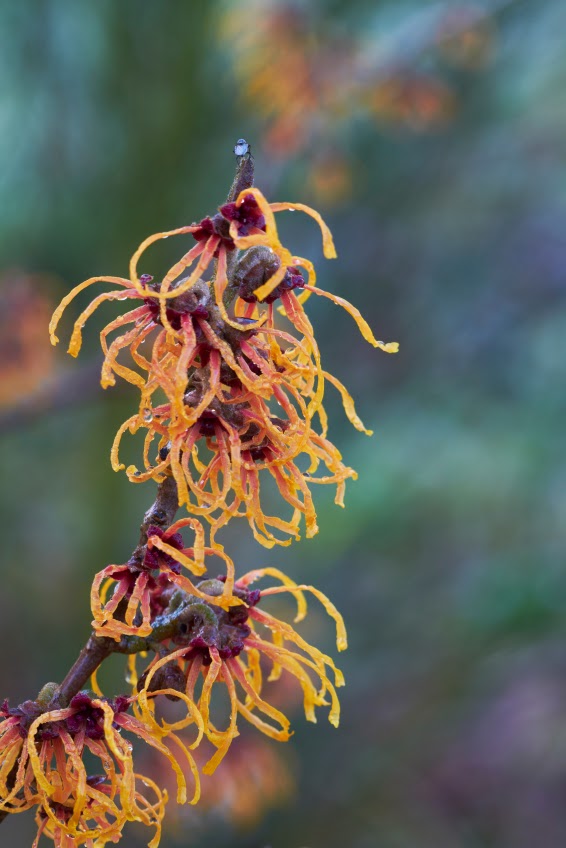
Witch Hazel's early bloom  is remarkable
Once the heavy snow is gone, put some organic fertilizer around the plants so as the spring rains come it will naturally work it into the soil.  I like to use Espoma products because they are ‘slow release’ and will not only feed the plants they also enrich the soil.  Using a small hedge rake I scratch the organic fertilizer into the soil at the drip edge of the plant (the distance around the plant that equals the length of the branches).

Late March is also a good time to start getting the sand  off the lawn-though, keep in mind that many towns will probably still sand through part of April.  If your lawn and/or flower beds that are close to the road—put down some gypsum, this will help the salt leach out of the soil faster.

I will also take the opportunity to flip any sod that had been plowed-up back into place so when the grass starts to grow it will root easier.

Also, when the days are getting longer I will start feeding my indoor plants again, as they also know it is time to awaken and start putting on growth after the long cold winter.  Spring is the season of rebirth, and feeding your plants now will give them a jump on the new season!


Thursday, March 13, 2014

Buffman and Gram's Vegetables for Vitality: Broccoli

As many of you know Allen, Sterling & Lothrop's fourth generation has been getting more and more involved in the business.  You may have met Jenn's (AS&L's seed room manager) daughter Nadia running the front with her grandmother, Shirley, or  you may have had one of Shawn's boys help you with a Christmas tree.

This year Buffman (Shawn's middle son) has joined forces with his grandmother, Shirley, to bring you their thoughts on the healthiest vegetable's you can grow.  They consulted Shirley's vast knowledge of gardening and nutrition and 
www.wiki.com
-------------------------------------------------

Broccoli is loaded with vitamin C, and is high in dietary fiber. If you could only eat one vegetable broccoli would be a good choice, because of its nutritional value. Broccoli is high in potassium which can help to normalize your blood pressure. Pick broccoli before heads loosen up. Broccoli requires plenty of fertilizer to give it a good start, and so it will produce a large head. You can get a good crop of broccoli by doing a fall planting, because the cool weather will give it an extra sweet flavor. Steaming and stir frying are two good ways of cooking so it doesn’t lose its nutritional value. Broccoli can also be eaten raw such as using it in salads or dips.

Thursday, February 20, 2014

Bill's Gardening Projects for February

This year our nursery manager, Bill, will be giving us gardening tips and projects for each month.
Late February or early March is often when I will do my dormant pruning of deciduous trees and shrubs (shade, ornamental, flowering trees like Red Twig Dogwood, Forsythia, Lilac, Quince, etc.) When I prune, of course, depends on the weather.

The obvious reasons for dormant pruning:

1)      Because the leaves are gone, it’s easier to see where to make the proper cuts.

2)      The sap is not flowing so you will lesson exposure to disease and insects.

3)      It, also, allows you to look at the overall shape of the plant to determine whether you want to reduce the size of the plant or maintain its current size/shape.  

When you prune a plant you should be looking to prune back branches that are crossing as well as dead or diseased branches.  Always make sure you use the correct tools and that they are sharp and clean.  For most pruning I carry Felco #2 hand pruners and a Felco pocket saw (which will accommodate most larger cuts).  Sometimes it’s necessary to use a pole pruner for higher limbs etc.  **Be mindful of overhead wires and other obstacles.

Make sure your cuts are clean and don’t leave jagged bark (jagged cuts gives easy access to water and insects ).  The pruning that you do at this time can eliminate a lot of headaches down the road.  It is also an opportunity to look at the beauty  and structure of the plant you don’t normally see during the growing season.

There are a couple of great how-to videos from the University of Maine Extension: