Friday, June 1, 2012

Bill's Picks for June


Golden Vicary Privet (Ligustrum Vicaryi):

 I have become very fond of this plant over the past few years both in my garden as well as observed in other peoples landscapes.  It has fragrant sweet small white flowers against bright yellow foliage.  This plant makes a great lower hedger or a stand by itself.  It prefers full-sun for the best foliage color but I have this on the northwest side of my house and it does quite well.


Dogwood (Cornus Florida, Chinensis):  

These are truly a multi-seasonal tree with variations of key-lime flowers turning to white then to pink followed by red fruits.  Some varieties exfoliate their bark as they age.  These trees are great lawn specimen and will blend well in the wood-line border with part sun.  “Kousa” is one of the industry standards and I have become very fond of the variegated foliage of “Kousa Wolf Eyes”.   


Clematis:

I think a clematis can fit into any landscape. The varieties of color, size, and bloom time are endless.  I have several varieties in my garden that bloom from late spring well into the fall.  Some varieties bloom early then rest and bloom again.  I’m particularly fond of some of the smaller bell shaped forms.

Wednesday, May 2, 2012

Bill's Picks for May


Here are some of my favorite harbingers of spring, when the plants seem to be telling us it’s time to awaken, with all their beautiful, bright colors of yellow, orange, lavender, pink, etc. Combining these with spring blooming bulbs like crocus, daffodils, tulips etc. can make you’re landscape come alive!!

Quince (Chaenomeles speciosa):  This is a great, old fashioned plant.  It has loads of blooms all over the bush and comes in many different colors—red, orange, pink, and white.  I have noticed that it is also a plant that small birds like to congregate in for protection; so planting one near your bird feeders would be ideal.  For those who like to make jellies and jams, quince has always been one of my favorites!


                                                         Shad Bush (Amelanchier):   
This is a hardy small tree with interest for all seasons.  The tree produces catkins which open into profuse white blooms in spring.  Persistent fruit for wildlife in summer.  Stunning foliage of yellow/orange and red in the fall.  The trees leafless structure and nice gray bark is set off nicely by the winter landscape.


Lily-of- the-Valley (Convallaria Majoralis):  When these emerge in the spring with their sweet fragrant blooms I love to give them as gifts in tiny vases.  I have used these as a wonderful ground cover along driveways and embankments, for erosion control.  Lily-of-the-Valley mixes well with both bulbs and plants that emerge later.

Tuesday, April 3, 2012

Bill's Picks for April

Here are some of my favorite harbingers of spring, when the plants seem to be telling us it’s time to awaken, with all their beautiful, bright colors of yellow, orange, lavender, pink, etc. Combining these with spring blooming bulbs like crocus, daffodils, tulips etc. can make you’re landscape come alive!!


Forsythia:  When I think of spring this plant is probably the first to come to mind with its bright yellow flowers.  Combined with all the other colors forsythia lets us know spring has arrived.


Pagoda Dogwood (Cornus Atteniflia): This small tree has become one of my favorites with its small star-white blossoms, dark berries (that the birds love), and dark burgundy fall foliage. It is a nice choice for a small tree either in a perennial bed or naturalizing along a wood line. I have found it to be quite versatile tolerating both shady and sunny locations—an under used tree.


Lungwort (Pulmonaria):  An  early spring gem!  Silver dappled leaves offset vibrant, irredesent pink or purple blossoms.  Perfect in shady areas where the silver markings can really glow!

Wednesday, October 5, 2011

Work In Process

 As many of you know our web-site was having problems and we needed to remove it from the web. We are in the process of having it rebuilt. We'll keep you posted on the progress.

In the meantime, you can reach us by phone: 207-781-4142
or
By email: lallensterlothrop.com


Hours:
Mon-Sat: 8:00am-5:30pm
Sun: Closed--we spend this day with God and our families.


Wednesday, February 9, 2011

Bill's Picks For February

AS&L's nursery manager, Bill Kennie, has some special picks for February--these plant are sure to cheer the winter landscape.

Elm (Ulmus):  There has been a big push to reintroduce the elm back into the landscape with most of the new varieties showing very good resistance to Dutch Elm Disease.  My family's farmstead has a very old specimen which has a long straight trunk and a contorted canopy...it is really a tree that offers interest for all four seasons.  I truly hope this tree will be used much more in the future.


Dowood (Cornus Alba, Sericea, etc.):  When I think of winter interest for shrubs this one comes in mind first. There are so many varieties of these hardy shrubs with colorful stems; red, yellow, orange, etc.  Against the backdrop of snow make these plants stand out in you're winter landscape.  Varieties range from dwarf to variegated foliage--dogwood offers blossoms for the bees, and berries for the birds.  These plants can find a home in any landscape--additionally, they are great for naturalizing an area.


In the Northeast, I'm sure many of us don't think of perennials for winter interest, but there are really many to choose from--especially for wildlife.  I have seen many perennial gardens left to go to seed making a perfect refuge with abundant food for wild life and birds.  Here are a few good choices.


  • Coneflower (echinacea)
  • Black-eyed Susan (rudbeckia)
  • Holly Hock (alcea)
  • Sedum (stonecrop) --pictured
  • Lavender (lavendula)
  • Japanese Spurge (pachysandra)-an evergreen ground cover
  • Grasses (most varieties)

Friday, January 7, 2011

Bill's Picks for January


As the January cold sets in, it's comforting to sit in the warmth of the house and enjoy the frosted, skeletal shapes of the winter garden.  Here are Bill's picks for January.

Golden Weeping Willow (Salix Niobe):  A mature weeping willow with its long cascading branches almost touching the ground is something to behold.  Not only does the form of this tree offer a lot of winter interest, it is an ideal choice for a wet area or near the edge of a pond.  This is a fast growing tree and needs lots of room to spread out. 


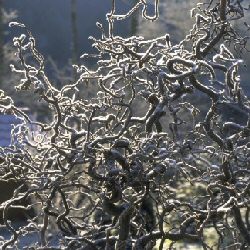
Harry Lauder's Walking Stick (Corylus):  These plants, from the hazelnut   family, are tough and durable.  The contorted branches in winter are spectacular; be sure to place them where you can see them from the warm comfort of your home.  I am a fan of the straight species with its abundance of nuts in the fall which are great for wildlife.  There are many new choices some with leaves of yellow or red.  Harry Lauder's Walking Stick is a nice focal point for a small garden or perennial border.


In the Northeast, I'm sure many of us don't think of perennials for winter interest, but there are really many to choose from--especially for wildlife.  I have seen many perennial gardens left to go to seed making a perfectrefuge with abundant food for wild life and birds.  Here are a few good choices.
  • Coneflower (echinacea)
  • Black-eyed Susan (rudbeckia)
  • Holly Hock (alcea)
  • Sedum (stonecrop)
  • Lavender (lavendula)-Pictured
  • Japanese Spurge (pachysandra)-an evergreen ground cover
  • Grasses (most varieties)

Tuesday, November 23, 2010

Bill's Picks for Winter Interest: December

Winter is a long season in Maine, so be sure to plant trees, shurbs, and perennials that will give your landscape interesting focal points during the winter months.  Here are some of Bill's favorites.